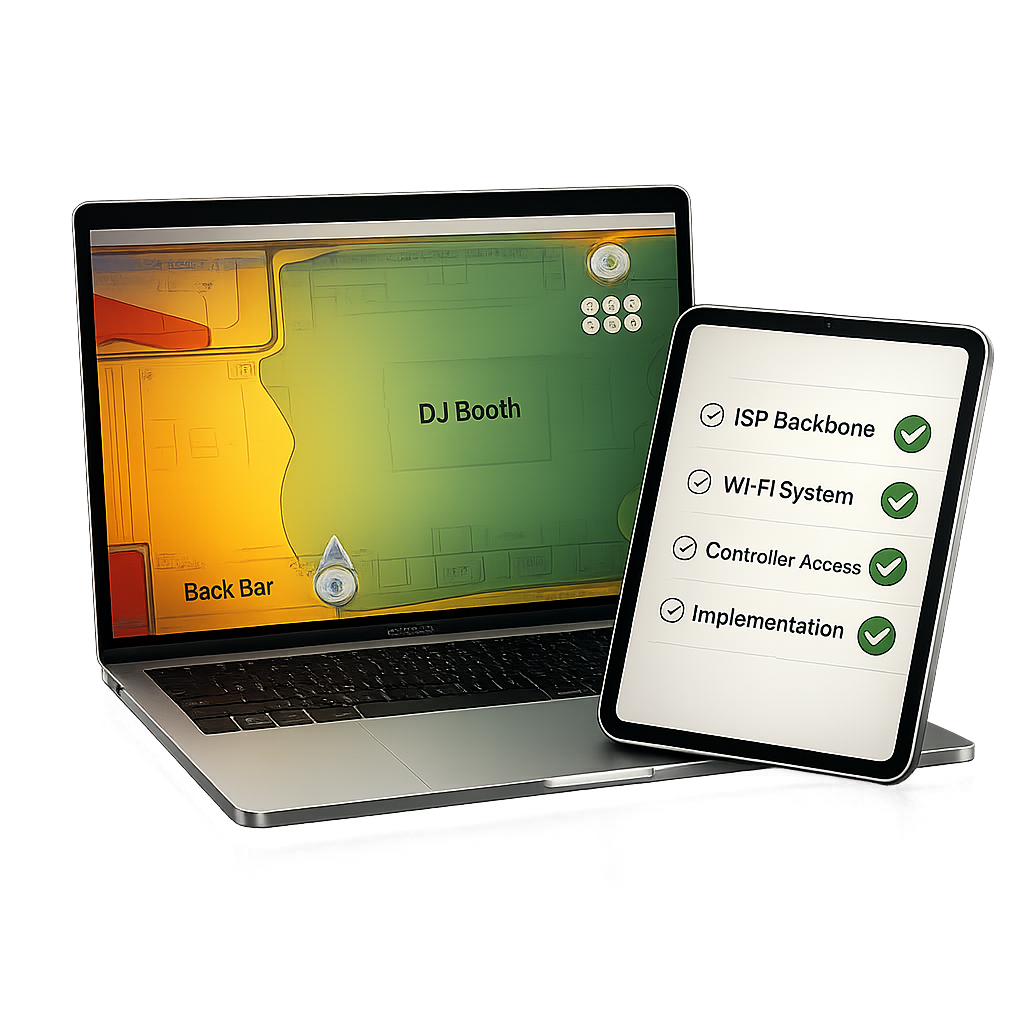

Most indoor connectivity projects stall before they start because traditional upgrades require construction, carrier coordination, and new infrastructure. A LongFi Connect deployment works differently by activating carrier-grade connectivity using the enterprise Wi-Fi your building already operates.
The list of requirements is long: new antennas, cabling, RF design, carrier negotiations per site, construction timelines. For a lot of organizations, seeing that list is enough to shelve the project.
A LongFi Connect deployment is built around a different premise: most buildings are already running enterprise Wi-Fi that carriers can use right now. The problem is not infrastructure. It is activation.
Here’s how that activation actually works.
What a Fully Managed LongFi Connect Deployment Means
It means your team doesn’t design, negotiate, or deploy a new cellular system. LongFi handles site eligibility, compatibility checks, carrier coordination, Passpoint configuration, and validation before go-live.
Your existing Wi-Fi stays in place. Network policies don’t change. Your IT team stays in control of the infrastructure throughout. Once a site goes live, indoor connectivity improves and the site starts generating recurring revenue from carrier usage.
Why Traditional Projects Feel Heavy
New antennas, cabling, construction, RF design—and a capital investment before a single device connects. That model makes sense for massive venues.
But a lot of buildings don’t need new cellular infrastructure. They need someone to activate what they’ve already built.
The Five Steps in a LongFi Connect Deployment
Discovery. We start by understanding your environment: locations, Wi-Fi platform, bandwidth, coverage, expected traffic. Mostly we’re trying to figure out whether your network is a strong candidate before anyone invests more time.
Qualification. Most enterprise systems—Meraki, UniFi, Juniper, Aruba—already support the features carriers require. In a lot of cases, no hardware changes are needed. If something does need adjusting, we say so before moving forward.
Carrier submission. LongFi coordinates with participating carriers: registering the location, preparing authentication parameters, aligning configuration. Your team doesn’t talk to carriers directly.
Configuration. Activation is a Passpoint-enabled network profile at the controller level based on the Wi-Fi Alliance Passpoint® standard It can happen through shared access, a guided session with your IT team, or self-implementation using our documentation. Nothing touches POS systems or internal device networks.
Go-live. Supported devices automatically connect through the carrier-integrated Wi-Fi layer. Coverage improves, usage reporting begins, revenue starts accumulating. Normal operations aren’t disrupted.
What Your IT Team Does During a LongFi Connect Deployment
Usually: approve access for configuration or review settings before activation. That’s the realistic scope of internal involvement in most deployments.
This is part of why LongFi works well across distributed portfolios—your team isn’t doing heavy lifting at each new site.
MSP Options
Three ways to work together, depending on how you operate:
- Controller access — LongFi engineers configure directly. Fastest.
- Guided configuration — Your team implements alongside LongFi engineers.
- Self-implementation — You deploy independently using our documentation.
Infrastructure ownership stays with the MSP or site operator regardless of which path you take.
What Stays the Same
LongFi traffic runs on a separate VLAN, uses a portion of available bandwidth, and doesn’t touch business-critical systems. Configuration happens at the controller level, so the same setup replicates cleanly across multiple sites without redesigning each one.
If you ever want to reverse it, you can.
Revenue
Once a site goes live, carriers route subscriber traffic through the activated network and pay LongFi based on usage. A share of that goes back to the venue or partner monthly. No subscription fees. No upfront infrastructure investment. More mobile traffic generally means more value over time.
Most partners start with a pilot and expand from there.
See If Your Network Qualifies
If your organization operates enterprise Wi-Fi infrastructure, there is a strong chance your network already supports LongFi Connect.
The next step is simple. We review your environment, confirm eligibility, and outline what activation would look like for your site or portfolio.
Start with a qualification review and see how quickly your network can go live.