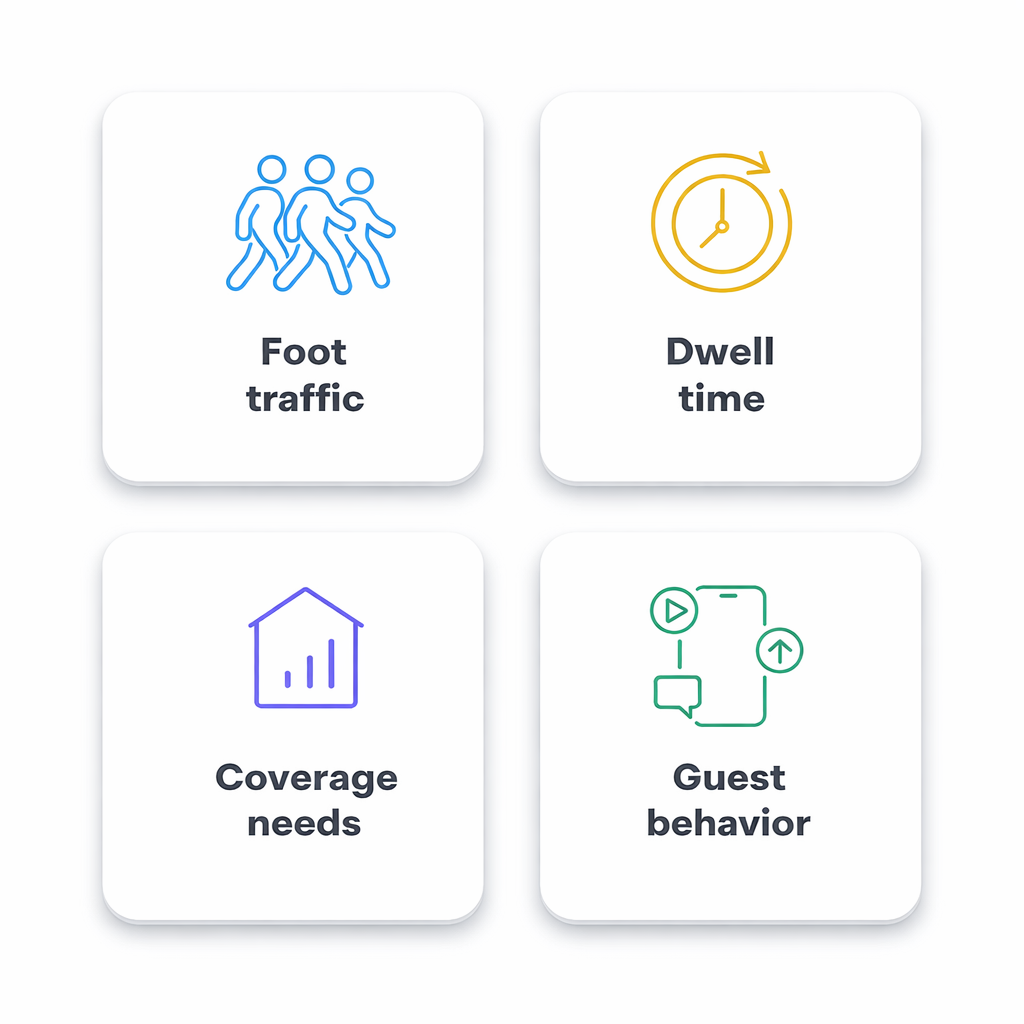

Every venue generates a different level of connectivity value.
With LongFi Connect, monthly payouts depend on how much indoor mobile data your location helps deliver for mobile carriers using your existing Wi-Fi infrastructure. Rather than installing new hardware, LongFi Solutions enables your enterprise Wi-Fi network to securely carry carrier traffic and turns unused wireless capacity into a recurring revenue stream. Cellular offload using trusted Wi-Fi infrastructure is already a recognized strategy carriers use to expand indoor coverage efficiently. [3]
Four main factors determine how much connectivity value your venue can generate.
Foot Traffic Increases the Number of Connected Devices
The more people walking through your doors, the more smartphones arrive with active mobile subscriptions.
Each of those devices already expects reliable cellular service indoors. When LongFi Connect is active, supported phones can automatically use your wireless infrastructure as part of the carrier’s coverage layer. More devices connecting means more carrier traffic flowing through your network, which increases the connectivity value delivered.
Locations that naturally see higher foot traffic include:
- Restaurants and cafés
- Hotels and hospitality venues
- Gyms and wellness centers
- Retail stores and shopping areas
- Clinics and waiting environments
- Event spaces and entertainment venues
If your space regularly hosts guests rather than only employees, it is already positioned to generate indoor connectivity activity. This matters because people spend roughly 90% of their time indoors and up to 80% of mobile data traffic is generated there, making indoor environments one of the primary service responsibilities for carriers. [1]
Longer Dwell Time Increases Mobile Data Usage per Visitor
How long guests stay inside your venue matters just as much as how many show up.
Visitors who remain on site for extended periods often:
- Stream media
- Scroll through social platforms
- Join video calls
- Use maps and navigation
- Upload content
- Browse continuously
All of these activities generate mobile data traffic that carriers are obligated to deliver. LongFi Connect allows that traffic to move through your indoor network environment instead of relying only on nearby towers.
Venues where guests typically stay longer often produce stronger connectivity activity because devices remain connected for more time. Video streaming alone now represents roughly three-quarters of global mobile traffic, which significantly increases indoor data demand in longer-stay environments. [4]
Indoor Coverage Needs Influence How Valuable Connectivity Becomes
Not every building interacts with cellular signals the same way.
Construction materials such as:
- Concrete
- Steel framing
- Energy-efficient glass
- Dense interior layouts
can reduce signal penetration from outdoor towers. As networks increasingly rely on higher-frequency spectrum for 5G performance, indoor signal loss becomes even more pronounced. [2]
Locations with greater indoor coverage challenges often generate more connectivity value once LongFi Connect is active.
Instead of requiring new antennas or distributed antenna systems, your existing Wi-Fi network can help carriers deliver the indoor performance their subscribers already expect.
Guest Behavior Determines How Much Traffic Moves Across Your Network
Different environments produce different types of mobile usage.
For example:
- A quick coffee stop generates lighter connectivity activity
- A waiting room produces steady browsing traffic
- A gym encourages streaming and music use
- A hotel supports continuous multi-device connections
- A sports bar creates high peak-time demand
Because LongFi Connect operates automatically in the background, supported smartphones connect without requiring passwords or manual sign-ins. As guest activity increases, the amount of carrier traffic delivered through your venue increases as well. Cellular offload frameworks like this improve user experience while reducing congestion on nearby towers, which is why carriers actively support them. [3]
That activity directly influences the connectivity value your location creates.
How LongFi Connect Turns Excess Wi-Fi Capacity into Monthly Earnings
LongFi Connect is a network integration service from LongFi Solutions that enables supported mobile carriers to securely route subscriber traffic through enterprise-grade indoor Wi-Fi environments.
Once activated:
- Supported smartphones enter your venue
- Devices authenticate automatically using SIM credentials
- Mobile traffic moves across your wireless infrastructure
- Carriers recognize the indoor coverage contribution
- LongFi shares resulting revenue with your location
Your venue is not selling connectivity to guests. It is helping carriers deliver the service those guests already pay for.
That is what makes the model effective across many different types of environments.
Why Venues Earn Differently From One Another
No two locations generate the same connectivity activity.
Revenue potential depends on how your space naturally interacts with mobile usage patterns. A high-traffic restaurant may generate strong evening peaks. A clinic may produce steady daytime usage. A hotel may support continuous overnight connectivity across dozens of devices.
LongFi Connect adapts to those patterns automatically.
The more your environment supports indoor mobile activity, the more opportunity there is to convert unused Wi-Fi capacity into carrier-supported connectivity value. This shift reflects a broader industry transition toward leveraging indoor infrastructure to meet growing mobile traffic demand. [4]
References
[1] Ericsson. Optimizing indoor connectivity – Ericsson Mobility Report.
https://www.ericsson.com/en/reports-and-papers/mobility-report/articles/mobile-broadband-indoor-deployment
[2] Ericsson. Planning in-building coverage for 5G: from rules of thumb to statistics and AI.
https://www.ericsson.com/en/reports-and-papers/mobility-report/articles/indoor-outdoor
[3] SIIT. Cellular Offload Economics: Why Carriers Pay for Passpoint-Ready Wi-Fi.
Cellular Offload Economics: Why Carriers Pay for Passpoint-Ready Wi-Fi
[4] Ericsson. Mobile network traffic update – Ericsson Mobility Report.
https://www.ericsson.com/en/reports-and-papers/mobility-report/dataforecasts/mobile-traffic-update