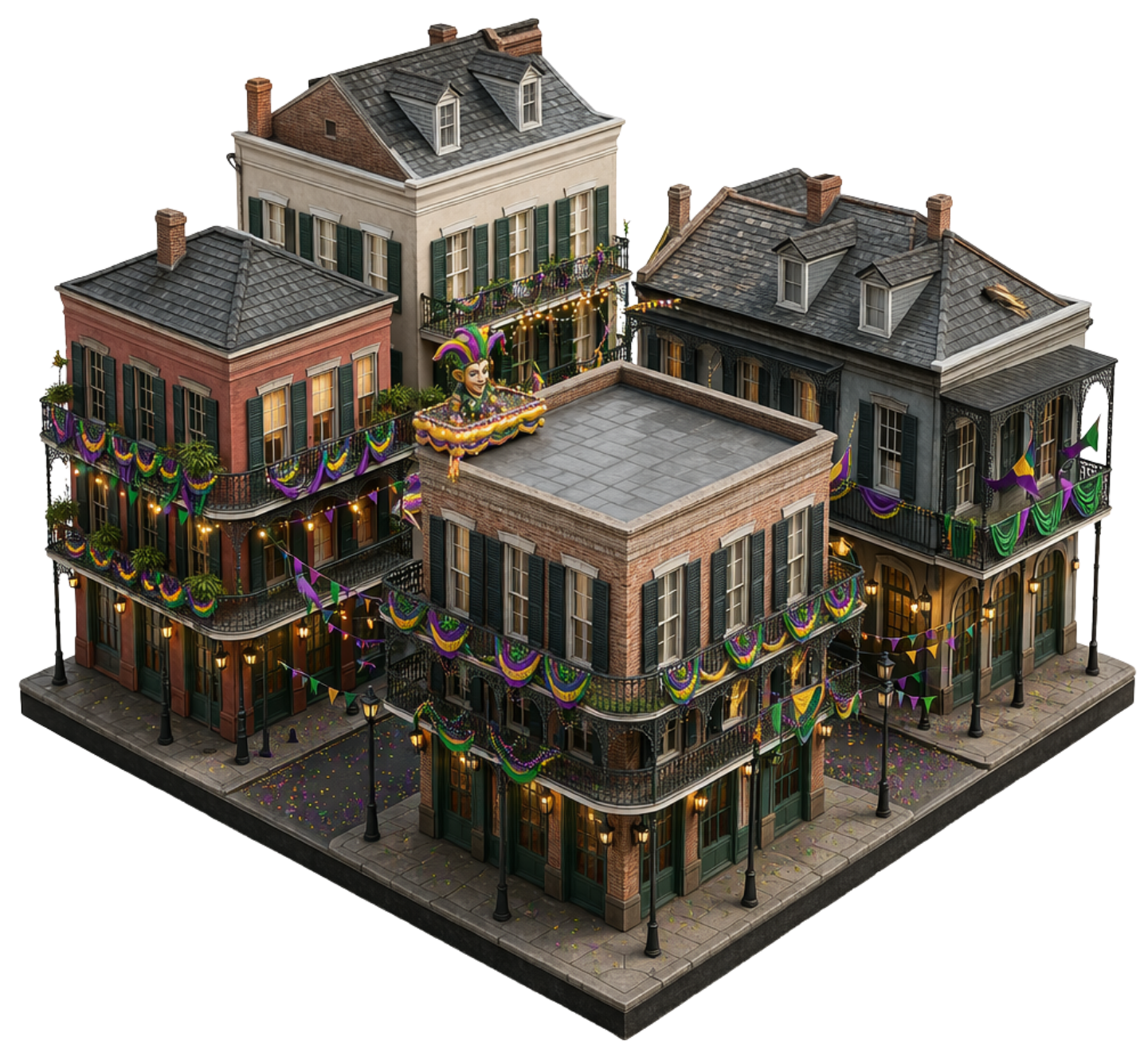

Mardi Gras is one of the most demanding live environments for wireless connectivity in the United States.
For a few days, New Orleans becomes a dense, fast-moving network challenge. Visitors gather across streets, restaurants, bars, hotels, music venues, and entertainment districts. People are using phones for maps, rideshare, payments, messaging, social media, ticketing, and safety coordination, often all at the same time.
That matters because Mardi Gras is not a small event. The 2023 Mardi Gras season generated an estimated $891 million in total economic activity for New Orleans, according to a Tulane University economic impact study [1]. In 2026, downtown New Orleans recorded approximately 2.2 million visits during the two-week Carnival period, the highest level of Carnival visitation since 2020 [2]. Mardi Gras is also part of a much larger visitor economy: New Orleans welcomed 19 million visitors in 2024, generating $10.4 billion in visitor spending [3].
In that kind of environment, indoor cell service is not a nice-to-have. It directly affects the guest experience.
During Mardi Gras 2026, LongFi Connect supported high-density carrier connectivity across active locations in the French Quarter using existing enterprise Wi-Fi infrastructure. The goal was simple: help participating venues keep guests connected without disrupting operations, replacing existing systems, or adding unnecessary infrastructure complexity.
The Challenge: Dense Crowds, Indoor Venues, and High Mobile Demand
Mardi Gras creates a unique connectivity problem.
Outdoor networks are already under pressure from crowds, parades, and street-level density. But the challenge becomes even more complicated inside buildings. Restaurants, bars, and historic French Quarter venues often have thick walls, dense interiors, and large numbers of people moving in and out throughout the day.
That combination can make it difficult for traditional outdoor cellular networks to deliver strong indoor service.
For venue operators, the issue shows up in practical ways:
- Guests cannot send messages reliably.
- Staff hear complaints about poor signal.
- Visitors struggle with rideshare, payments, or sharing content.
- The venue experience feels less seamless during the busiest revenue days of the year.
LongFi Connect was designed for exactly this kind of environment. It uses existing enterprise-grade Wi-Fi infrastructure to create a secure carrier-integrated connectivity layer, allowing eligible mobile subscribers to connect automatically and securely through the venue’s Wi-Fi network.
Mardi Gras 2026 Performance Snapshot
During Mardi Gras weekend, LongFi Connect helped support large volumes of authenticated carrier traffic across participating French Quarter locations.
Key results from the Mardi Gras 2026 deployment included:
- 140,000 peak daily subscribers
- 32 TB transferred during event week
- 35 active locations supporting deployment
These results show how existing enterprise Wi-Fi can do more than serve traditional guest internet access. When properly configured, it can help improve indoor cell connectivity while creating measurable incremental value for participating properties.
What Venue Operators Experienced
The most important result was not just the volume of traffic moved through the network. It was the operational impact inside the venues.
Nick Genovese, General Manager of The Original French Market Restaurant & Bar, described the change clearly:
“In previous Mardi Gras weekends we would hear complaints about cell signal inside our venue. This year we didn’t have a single one.”
That is the outcome LongFi Connect is built to support.
For high-traffic venues, better indoor connectivity is not abstract. It means fewer complaints, smoother guest experiences, and less friction during the busiest moments of the year.
Why Existing Wi-Fi Infrastructure Matters
One of the strongest parts of the Mardi Gras deployment is that LongFi Connect did not require venues to rethink their entire network strategy.
Instead, the solution used existing enterprise Wi-Fi infrastructure where available. That matters because many venues already have capable Wi-Fi systems in place, but those systems are often treated only as an operating cost.
LongFi Connect changes that equation.
By activating a carrier-grade layer on compatible enterprise Wi-Fi networks, venues can support better indoor mobile connectivity while participating in a usage-based revenue model. Mobile carriers pay LongFi for eligible subscriber data routed through the network, and LongFi shares a portion of that revenue with participating venues and partners.
In a high-density event environment like Mardi Gras, that creates a practical win for everyone involved:
- Guests get better connectivity.
- Venues reduce complaints.
- Carriers improve subscriber experience indoors.
- Existing infrastructure works harder.
- Participating properties can earn incremental monthly revenue.
Why Mardi Gras Is a Meaningful Test Case
Mardi Gras is a useful benchmark because it compresses many of the hardest connectivity conditions into one environment.
There are dense crowds. There is constant movement. There are indoor and outdoor coverage transitions. There are hospitality venues operating at peak capacity. There is heavy mobile usage from both locals and visitors.
A solution that performs in that environment can be relevant far beyond Mardi Gras.
The same principles apply to:
- Entertainment districts
- Hotels and resorts
- Convention centers
- Sports bars and restaurants
- Music venues and nightlife districts
- Retail centers
- Stadium-adjacent businesses
- Municipal corridors and tourism zones
Any location that depends on visitor experience can benefit from stronger indoor cell connectivity.
From Event Performance to Everyday Value
Mardi Gras creates an extreme version of a problem many venues deal with every day.
Guests expect their phones to work everywhere. They do not think about macro towers, building materials, indoor signal penetration, or Wi-Fi offload architecture. They simply expect messages to send, apps to load, payments to work, and rideshare to connect.
For venue operators, that expectation becomes part of the customer experience.
LongFi Connect helps venues meet that expectation by turning existing enterprise Wi-Fi into a secure, carrier-integrated connectivity layer. During Mardi Gras 2026, that model supported high-density performance across active French Quarter locations, moved significant carrier traffic, and helped operators reduce one of the most common guest complaints: poor indoor cell signal.
For venues, municipalities, and business owners preparing for high-traffic seasons, the lesson is clear.
The infrastructure needed to improve indoor mobile connectivity may already be in place. It just needs to be activated correctly.
References
[1] [Tulane University School of Liberal Arts] – The Biggest Free Party on Earth, the Economics of Mardi Gras
[2] [FOX 8 / WVUE] – New Orleans sees largest Mardi Gras crowd since 2020
[3] [New Orleans & Company] – New Orleans Reaches Tourism Milestone: 19 Million Visitors for the First Time Since COVID